Stunning Home Theater Paint Color Ideas

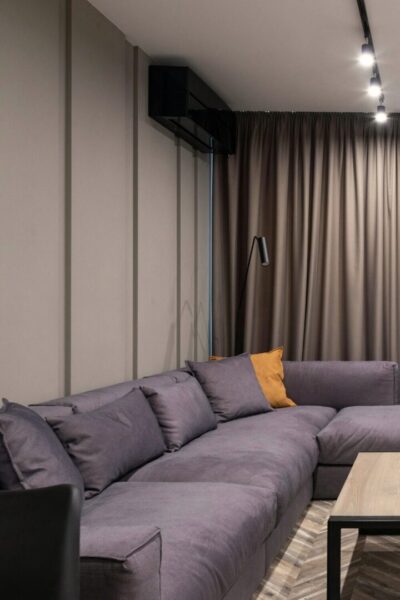
A blue couch in a room with brown walls; which is one of many home theater paint color ideas

Stunning Home Theater Paint Color Ideas! (For A Better Movie Watching Experience)


A blue couch in a room with brown walls; which is one of many home theater paint color ideas.

Home theater paint color ideas can be classified in 3 categories of colors; dark & neutral colors, primary colors, & custom color designs. These are further broken down into smaller subcategories monochromatic, analogous, & splitcomplimentary. The best home theater paint color schemes are darker as these help reduce reflected light on the screen, giving better picture quality in your content!


A major part of really ensuring that authentic, quality, home theater experience is feeling comfortably immersed where the enjoyment of that content takes place.

That’s because truth be told, your surroundings play just as much of a role in the experience as the speakers and display themselves.

Whether it’s a small home theater or large media room, the actual color of your entertainment room in particular plays a huge role believe it or not; yet it’s something that could easily be overlooked.

If done right however, it can make a massive difference in the overall feel of the room — making it really feel like you’re at the movies.

So that’s why today, we’ll be taking a look at a few different home theater paint color ideas you can use that hopefully inspire some awesome home theater color schemes of your own.

That way, not only are you able to find the color theme that best works for you, but can also be confident that you’re getting the best possible experience to fully utilize what you currently have.

Different themes work best for different situations though, so we’ll also be looking at what works best when, and why.

This is going to be a fun one, so get comfortable, and let’s get into it! 😀


Deciding What The Room Will Be Specifically Used For

A media room with couches

So before you do any painting, rearranging, etc, you’ll want to first make note of what exactly the room you’re planning your home theater in will be used for.

Will it be used for exclusively watching movies? Or perhaps it’ll be a more casual room used for watching TV with the occasional movie thrown in?

Maybe it’ll be a game room for playing video games, or perhaps it’ll be a little bit of everything in the form of a man cave?

The reason why it’s so important to figure this out first thing is it’ll have a direct influence on the color that’ll work best for the room.

Choosing the right home theater paint color schemes can give the room an entirely different feel and help improve the movie watching experience quite a bit.

If you know that the room will primarily be used for movie watching, it’ll probably be best to use darker colors or even black since it’ll do a better job in that regard.

A light grey room with sunlight coming inHowever if it’ll be used for more casual viewing, then you’ll likely want to go with lighter colors as it’ll make the space feel more open — rather than feeling constricted like it could with a darker color; especially with watching in the day time.

A mix of different viewing conditions would likely benefit from a somewhat darker room color like a burgundy for example, since it’ll essentially provide the best of both worlds with regard to not feeling too enclosed — while also doing a decent job with handling light.

The point is, take into account who will be doing the content consumption, the kind of content that’ll be used in the room, and the actual furniture & decorum in the room before deciding on a color.

That way it’ll compliment, rather than hinder, your viewing environment for your specific situation.

Remember lighter colors reflect more light no matter what the material of the wall might be so the lighter the color you choose, the more light that may potentially reflect back onto your screen

This is why grey and darker colors are generally thought of as better for watching content because they offer such a good balance between practicality while still making the room feel like a genuine home theater.

Though using colors that are dark are helpful when it comes to viewing, ultimately it’s going to depend on your preferences.

Once you’ve got that figured out, it’ll be much easier to decide on the color, which I’ll provide examples of a little later on.

First though, there’s something else you’ll want to keep in mind (well technically a few things)..


Taking Into Account The Lighting Of The Particular Room


A couch with ambient lighting radiating from the wall

Another very important thing to take into consideration is the lighting conditions of the particular room too.

Depending on what it’ll be used for, you’ll want to find the right balance between immersion and watchability.

What I mean by this is let’s say you have a room that you really only plan on watching shows in, but you recently felt compelled to repaint the room just to give it a different feel.

Well while you definitely still could, it wouldn’t really be necessary to paint the room a darker color since that need for extreme image precision that a darker color provides wouldn’t be something that’s necessarily important — especially if you happen to be a more casual viewer who might also have others that watch from time to time as well.

This is especially true if you watch your content in the day time as a room with a darker tone may dull things quite a bit.

I’ve also personally found that daytime viewing in a room with darker colors can sometimes lead to the room not really feeling the same as with a brighter color in a way.

Not saying this is what will happen in your case, but it’s just something that I’ve personally noticed from my experience so it is something to keep in mind.


However that being said, let’s switch gears and also say for example, you want to transform your current room into a full dedicated movie room.

In this case then, you’ll want everything including external lights to be as dark as possible, as that’ll have a beneficial effect with regards to picture quality.

But the big variable in both of these scenarios is the amount of light present both internally and externally, as this can alter the experience dramatically — which can be either good or bad.

A picture of sunlight shining on a television screen

So how exactly do you optimize for your specific use case though?

Well the first thing you’ll want to do is make note of any windows in the room and how they affect the screen from your seating position.

Do you often find sunlight drowning out the screen making it hard to see?

Or is the room simply bright from the sun light entering the room?

If so that’s the first thing you’ll want to immediately address.

Now there’s a bunch of ways to do so, but one of my favourites is using black out curtains.

These block a majority of light and so will immediately make things more visible on screen.

Plus they look pretty cool too.

Check Availability Of Yakamok Blackout Room Darkening Curtains


There’s also things like retractable shades and black out blinds which can help too. Basically anything capable of blocking any extraneous light is helpful in this case.

But that’s just one part to the proper lighting equation, as watching in complete darkness can get jarring over time, potentially leading to eyestrain from the contrast of a dark environment and bright screen.

Not to say that a completely dark viewing environment isn’t best for image fidelity, because honestly it is.

But if you do plan on watching for extended periods of time, (and I’m talking about hours on end here) then either taking a break every so often, or lowering the backlight of the display can help alleviate this.

Another thing you can do to strike a proper balance between great image quality and practicality is using ambient lighting.

Of course the room should be somewhat dark, but you’ll also want enough light so that people can move around safely too.

There’s certainly a myriad of ways to go about this, but one of my favorite ways is to use track lighting as it allows for directionality since you can actually focus where the light shines.


This works amazingly well since you not only have control over it, but it’s diffuse enough to where it won’t cast a glare on the screen if set up correctly.

Led lights on the back of a television

An ambient light in the form of an led light strip set up on the back of the television also works beautifully, and can offer even more customizability in the way of brightness and even color.

It also has the added side benefit of helping reduce eyestrain so there’s always that too.

You can even use dimmer lights since that’ll also allow you to control the intensity of the illumination in the room — offering just enough light to where it’s immersive, but providing enough visibility to see your surroundings should you need to move around.

Things like tabletop lamps and fluorescent lights should be avoided as they don’t provide the proper diffusivity for a satisfactory experience.

Not only that, but they’re also likely to cast a noticeable and localized glare on the screen which can be incredibly distracting.

That of course does depend on the type of screen you’re using though; as a matte finished television and/or projector screen won’t suffer nearly as much (if at all) from this issue which might allow for that type of light source.

Even then, the ones I mentioned before will still provide for a more optimal experience.

So try to stick with a light where you can control the direction as well as brightness and you’re golden.

An adjustable freestanding lamp

A standalone lamp that can be dimmed can also work too as long as it’s not directly aimed at these screen.

On a side note and if you’re especially meticulous, then you can even consider the color of the light as well.

This is a good piece that goes over that, but basically the gist is that warmer colors are not only easier on the eyes, but give a sense of comfort as well.

So should you wish to get the absolute best in terms of optimization of your room, then this is something else to make note of.

The following is an example of a lamp I feel works really well.


Check Availability Of Miroco LED Floor Lamp


Material Of Flooring Also Makes A Difference


A close up of a hardwood floor

Although the color of the flooring will make a small difference when it comes to things like light reflection, the material of the floor itself will make a much bigger difference in terms of overall light management and even sound quality.

You may want something that compliments the color of the room of course, but not in a way that makes things seem mundane or samey.

How you choose to do that is subjective, so that’ll really depend on your own personal preferences as that may be something you prefer.

An important thing to remember though, is that the actual material used is much more important and where the real focus should be; as something like a shag carpet for example, will do a much better job at dampening both light and sound waves than say a hardwood floor would.

So the more soft materials and carpeting present in a room, the better it’ll be for sound and picture quality as a whole.


Color Of The Furniture & Decor Present


A picture of a dark grey couch

Similar to what was mentioned previously about flooring in terms of coloring and material, the same applies when it comes to the furniture and decor present within the room.

Of course style will be subjective, but what I personally do is go for decor that adds a sense of punctuation to the room without being overly distracting — since the focus really should be on the screen and the speakers.

This is an area where you can really get creative and give the room personality. How you choose to do this will ultimately depend on how you actually plan on using the room, so keep this in mind beforehand.

That said, here’s a few seating ideas that may prove useful.

https://easyhometheater.net/home-theater-seating-ideas


What Type Of Paint Is Best For A Theater Room?


A picture of a paintbrush

Before we get into the different colors and themes, something really important to note is that the type of paint you use for the room actually does matter quite a bit believe it or not.

Glossy type paints tend to reflect light, which can produce glares; the opposite of what’s optimal.

Due to their reflective nature, glossy paints reflect light bounce from the walls and ceiling on to your screen.

Not only can too much light in your home theater room cause a glare, but this excess light can also wash out the picture, causing the image to look dull or drab by comparison.

To avoid these issues, the best type of paint to use is a flat, matte based paint in my opinion since that will cut down glare and reduce light reflection, allowing for much better viewing conditions.


This is also because matte paint has light absorbing properties when it comes to indirect and direct light.

It also has the convenient bonus of hiding any minor imperfections that may exist, allowing everything to look uniform and even.

You can even apply multiple coats of paint to achieve the darkest shade, which will help with even further minimization of light reflection including from the screen itself.

Projector paint is similar in this regard but comes with the additional benefit of allowing you to use the wall as an adequate projection screen since the matte finish of the paint won’t reflect light back towards you — making this another good option to use in a room.

A picture of a patterned wallpaper on a wall in a room

Adhesive wallpaper can work too, as there many different color options and even finishes including matte.

So if you’re not big on painting, this could be something to consider as well.


Dark and Neutral Colors & Where They Should Be Used


A picture of a couch with slight lighting emanating from a window

So in terms of the best colors to use for a home theater room, darker and neutral colors in the form of a matte paint are best as they provide the proper light reducing properties that often benefit visual content.

Think about the last time you went to the movies and try to remember what the room looked like.

Chances are, the room was likely a darker shade along with the furnishings; likely even the seating as well.

This is done to provide the most immersion while reducing as much light as much as possible.


Darker colors put the more focus on the content by not calling attention to themselves which further enhances the experience.

But as I’ve mentioned before, this is where knowing the type of room you want beforehand is key as you may want to keep some sense of versatility with the room; especially if you’re using it for more than one purpose.

If it’s a room where you plan on doing a lot of day time watching, then an entirely black room might not be best, whereas, a dedicated home theater room with primarily nighttime viewing probably would be.

It really is going to depend on your specific use case.

Ideally, if your only focus is watching movies & you want to get the best image quality possible, and it’s in a darker environment, then using darker colors for the walls and drapes would be better for dynamism.

Now with all of that being said though, let’s look at a few specific dark/neutral colors I think work best to inspire home theater paint color ideas you can implement & use — along with exactly why.


~ Matte Black


So keeping in mind the fact that darker room colors are best for light reduction, what better color to achieve exactly that than matte black?

Using a matte black theme for specifically watching movies is the most ideal color scheme in my opinion as it reduces the most light which helps the viewing experience.

However the thing is, its practicality can be questionable if you’re using the room for more than just movies since it can be tiring on the eyes in brighter conditions.

Just to reiterate, if your planning to just watch movies and use it as a dedicated theater room, then by all means — matte black is certainly the best option since it’ll provide for the best immersion in terms of an optimal home theater wall color.

But If it’ll be used for more than that, then there may be better choices to go with.

A big reason for this is that due to the light blocking capabilities of matte black, the effect that smaller light sources like lamps and such have on a room will be reduced even further.

This can be especially problematic for the instances where you’re not watching something and need to get around the room. If those happen to be your only sources of light, then it may not provide enough visibility.

Again, it all depends on your particular use case though.


~ A Darker Shade Of Grey


A picture of a dark grey wall color

A good middle ground for versatility when it comes to properly managing the balance between optimal ambiance and actual utility in regards to designing a home theater room is the color grey.

It has the capability of providing enough light reduction for an exceptional viewing experience, while also being neutral enough that it looks in good in every day life.

Plus an interesting benefit I happened to notice is that it doesn’t tend to reflect extraneous color back onto the screen, which in theory, could provide for a more pure image quality.

Whether this is always the case or even noticeable is likely debatable, but the main takeaway is that it’s certainly a great color to use that works in a variety of conditions.


~ Darker Brown


A picture of a dark brown room

Brown can also work as a suitable choice for a room I feel like when done right.

In my opinion, a subtle cinnamon or umber color tone specifically tends to give a nice enough balance to the room while maintaining a sense of sophistication.

Also when paired with a lighter brown, it can create a nice effect, adding depth and intricacy to the room.


Primary Colors & Where They Should Used


~ Dark Blue


A picture of a dark blue room

A really versatile option and one of my personal favorite color choices when it comes to the primary colors is to use a darker shade of blue within the room.

Not only is it relatively similar to black in regards to light reduction & maintaining a dark enough atmosphere when it comes to time to watch a movie with the lights on, it still provides enough color to give the room a nice look.

When it comes to blues, there’s a lot you can use, but a few I think work particularly well are evening, oxford, and navy blue.


~ Darker Red


A picture of a burgundy colored room

Another example of a pretty versatile color choice and great paint color idea is some sort of darker red.

Darker tones of red are a common color choice in many cinemas as it has somewhat similar light dampening properties to black, while still retaining that extra touch of color.

A ruby or even garnet color is a good choice to go with if you’ll be using the room for more than movie watching as it provides a dark enough setting for movie watching, while also giving the room a distinct look with other scenarios.

There’s many shades that would work, but those are just a few examples that look nice in my opinion.


Custom Color Schemes & What To Keep In Mind


A picture of multiple cans of paint

You of course always have the option of coming up with your very own color scheme mix when it comes to the colors of the walls and furniture within the room.

While there’s many different color combinations you can use, the 3 I personally think work best when it comes to home theater color schemes in particular are monochromatic, analogous, and split complimentary.

Wait what?

Don’t worry, I’ll explain each of those, along with why and where I think they work best.


Monochromatic Color Design


A picture of a monochromatic image of a living room with black and grey throughout

Monochromatic color is using the same color or similar shades of the same color across everything in the room, ranging from your decorum and furniture, to even your walls and ceiling.

This is in my opinion is the best for those that specifically plan on using their room for strictly movie watching because it forgoes the usage of loud colors, and subsequently places a much heavier emphasis on the focal point of the room, the display.

For example going with a matte black finish for the walls coupled with a dark grey overtone for the seating & decorum — in tandem with a subtle down lighting and muted carpeting is a look that can work really well.


While it does provide the most immersion for sure, the reason why I feel it works best only for this particular scenario really relates to the biggest drawback to this type of theme; and that’s monotony.

If this is a multi purpose room where you might have guests over in the day time for example, it could be seen as lacking flair or real character.

Having everything the same or similar color wouldn’t feel the same as having the splashes of colors other rooms might have.

So if you think the room will be used for more than that, then there’s certainly more suitable themes for that purpose.


Analogous Color Design


A picture of a room with pillows that are different shades of blue

Analogous Color theming is a little similar to Monochromatic in that they may use similar colors, however the difference with this one is that it uses multiple colors & shades that are close to one another on a color wheel.

This allows for enough variability that you can give the room enough decoration without things being too distracting at night.

It’s a good choice if you do plan on the room being multi purpose since it allows for a good amount of depth when it comes to design, while still giving you a fully immersive experience with movie watching.

An example of this is making a blue themed theater room where there’s a dominant & darker shade of blue — complimented by lighter shades of blue and indigo, topped off with various adornments throughout.

It would give enough variability to look captivating, while still sticking to the cohesive nature of the theme.


Another example is perhaps you decide on a garnet color for the walls, with a walnut hue for the furniture, and darker mahogany strip running through the middle of the room serving as a sort of statement piece for the rest.

The point is, it undoubtedly allows for a myriad of choices — so chances are you’ll be able to find something that works for you and your particular preferences with analogous design as a basis for the color scheme of the room.


Split Complimentary Color Design


A picture of a green room

Spilt complimentary gives the widest creativity range of the 3 color schemes mentioned here as it provides you with the ability to use a base color, and 2 adjacent colors of that original’s complimentary color.

For example you could use dark green for the walls, and then accent it with different tones of brown and even purple for a unique yet cohesive look for your room.


It’s certainly the most varied out of the 3 color designs since you do have so many possibilities, but once you get it right it can look really amazing.

Something to also keep in mind that’ll also help when it comes optimal image quality is using a darker color around the display as a border.

This will provide a bigger contrast between the screen & the room, while also helping to mitigate light pollution and reflections around the screen.

If using black for the room or even wall of the display isn’t feasible for the theme that you’re planning, try to use a darker color for a similar effect within the room.


A Custom Design


A picture of a colorful room

These are all just suggestions of course, since you can always tweak these by adding your favorite color decorum as accent pieces, or simply coming up with your own theme all together entirely.

The reason I chose those 3 color schemes in particular is that I personally feel they do the best job of balancing aesthetics, immersion, and cohesion within the room.

But there’s a plethora of possible combinations really, and that includes creating your own.

One theme I personally enjoy is black walls with red seating as I feel that just looks incredible.

However for you that might be entirely different.

But that’s what makes home theater in general so great honestly, since you have the ability to truly make it your own.


Final Thoughts


A picture of a subtle downlighting cast over a brick wall

Well, that about does it for this one.

Hopefully you found these paint color ideas helpful, and after this, have in mind a few color schemes that might work for your particular room or space.

There’s certainly a lot in the way of customizability and even things to consider, but that just means you have the capability to create something that truly looks incredible.

If you have questions or concerns though, definitely reach out and I’ll be more than happy to help.

Until next time, make it easy, keep it simple.


Samsung HW-T650 Soundbar Review

Samsung HW-T650 Soundbar Review


*Another model to consider that may also be of interest to you is the Samsung HW A550 which is a great alternative to the one talked about in this review.

I bring this up because due to it’s age, availability of the older T650 model might be difficult; but the newer HW A550 is not only as good as the one talked about, it’s arguably better then the originally reviewed sound bar honestly.

Most of the positives mentioned hold true with this one as well, with the added benefit of features like bass boost, even better sound quality, and game mode.*

Samsung HW A550 


Samsung HW-A550 Review


How’s it going everybody? Sincerely hope you’re all doing well.

This is going to be the Samsung HW-T650 Soundbar review, a deep dive into a sound bar that I personally feel is quite awesome for what it does.

But what’s the reason for that exactly, and more importantly, will it specifically work for you?

Let’s take a closer look and answer all of that and more in this easy home theater review!


Appearance


Now in terms of appearance, it’s honestly quite the interesting design at least as far as sound bars are concerned.

There’s a flush metal grille on the front that covers the drivers, that sort of curves out on the top and bottom to give the overall casing a unique shape.

On top of the bar is where you’ll also find the power button, pairing button, and volume up and down control should you wish to adjust things manually rather than using the included remote.

On the top is a brushed aluminum finish with a small Samsung logo placed to the upper left.

The included subwoofer is pretty standard with a removable cloth grille that also has a small metallic logo placed towards the bottom, and large bass reflex port on the back to minimize distortion.

I personally love the way this sound bar looks because it’s different enough that it’s able to differentiate itself while not doing so to the extent where it’s outright distracting.

The fact that it’s able to do this is certainly a testament to the level of attention to detail that Samsung was able to incorporate as there’s not exactly too many form factors you can really do when it comes to sound bars — especially when considering the function of a sound bar is to provide quality sound with the sound drivers themselves having to be in a certain arrangement to actually fit said description.

So given that it’s able to provide a different enough look through a culmination of subtle details — from the brushed aluminum, to the chamfered edge dividing the grille from the rest of the cabinet — is certainly something to appreciate.

It’s a design I feel would look good in most rooms as it isn’t hulking in size to the point where it’s blocking part of the TV. It’s subdued yet refined, which I feel adds a lot to the overall feel.

It definitely looks really nice in person.

Even the subwoofer, though simple in design, feels and looks quality. It’s a look that won’t stand out incredibly which some may appreciate, since ultimately the focus should be on sound and anything extra is really icing on the cake.

Again I personally like the presentation that this duo provides as I think it adds to the room without overdoing it, but of course, that’s up to the discretion of the individual when it comes down to it really.


Specs & Features


When it comes to down to features, the HW T650 certainly has a few interesting ones.

One of the main ones though that I’m sure a lot will be happy to hear is the offering of full Bluetooth support. But not just any bluetooth support, it actually has the ability to support 2 different connections at the same time.

That means whether you want to enjoy your shows wirelessly, or choose to listen to all your favorite music off of your smart phone or tablet, you’re able to do so while switching between them seamlessly which is awesome.

Another cool feature supported here is what Samsung is calling its smart sound technology which basically analyzes the sound signal coming in and optimizes it in real time for the best performance.


So say for example you’re watching a music video with this mode on, then you decide to watch a movie, the sound bar is able to adjust the audio on the fly to provide you with the best sound with no input needed from the user.

If you happen to be a gamer, there’s also a dedicated game mode that actually boosts sound effects; and surprisingly well at that — though it’s important to note that this feature only works with specific Samsung televisions.

Keeping on that same theme, if you do happen to have a Samsung television, powering the television on and off will do the same for the sound bar, and the included remote is able to control both.

It’s a minor thing, but it’s the little attention to details like that that make the entire experience that much more enjoyable; and not to mention simple!

The sound bar also has a small led display that shows simple info like the the sound profile or input you’re on for a quick reference point which is also a nice touch.

The included remote, aptly named one remote, allows you to easily control everything when it comes to the sound bar allowing you to customize everything the way you want it.

In terms of specs, the sound bar measures 38.6 x 3.5 x 2.3 inches, and weighs 5.3 pounds.

It also has support for the many of the major sound formats such as LCPM 2.1, Dolby Digital, and DTS 5.1 channel support  – with support even being present for the newest formats as well such as DTS:X.

DTS:X basically allows for you to get the full surround sound experience without the need for speakers all around you. It basically gives you a 3D sound all from a single sound bar.

There’s an HDMI ARC input for passthrough to the television along with an with an HDMI output.

There’s an optical input as well as a 3.5mm jack. There’s also support for USB music playback. It can also be wall mounted via the included wall mounting brackets and screws on the back, which luckily aren’t visible once it’s installed on the wall.

Surprisingly, there’s even a dedicated center speaker in the unit which allows for a much more engaging experience due to the crystal clear dialogue and sound separation it provides.

On the subwoofer side, it’s wireless (save for the actual power cord) and measures 8.1 x 13.9 x 11.9 while weighing 13.7 pounds.

The total system power is rated at 340 watts and is also ENERGY STAR certified.


Setup


Now there’s multiple ways to set this one up given the fact that it has optical, HDMI, and bluetooth support, so the way you do this will depend on your particular setup and television.

If your TV is a Samsung and/or is a newer one with bluetooth then this is one option and most likely the easiest as you’d just have to connect the power cable to the device itself and pair the 2. To confirm they’re actually paired, you can check in the device list to make sure the TV actually detects the signal.

If your TV is older and doesn’t have HDMI ARC passthrough, then you’ll have to use the included optical cable to connect from the sound bar to the back of the television, then go into the menus to ensure it’s set on the right input on both the TV and the sound bar.

The final way is if you have a display that does support HDMI ARC – as all you’d have to do in that case connect the HDMI cable from the sound bar to the TV. The subwoofer plugs into an outlet for the power with the included power cable, and pairs with the sound bar.


How It Sounds


So what about one of the most important questions though, how does the HW T650 actually sound?

To be quite honest, extremely good.

I’d say that as a whole, it has a pretty neutral sound signature; not really favoring either end of the spectrum. Of course there’s the option of going into the menu and adjusting settings like treble and bass, but by itself without doing anything, the quality of the sound itself is pronounced and crisp without being overly bright or harsh.

I’ve found that some soundbars tend to over exaggerate the treble resulting in a slight hiss with some content, but luckily that definitely isn’t the case here.

It’s just a really balanced and pleasing sound that quite frankly, actually sounds really good, even at higher volumes.

I would say that even the mids are well represented here, giving voices crisp and realistic tone. Like for example with watching a movie, even at higher volumes, no one note seems to be in excess over another, with everything from the bass to the high end being equally present (and at 340 watts, this thing can get loud!)

Even In normal instances and at normal volumes, it’s just a really clear and present sound. I know I’ve said that already, but it really is the best way to describe it.


I’ve noticed with some sound bars in the past, some scenarios where the low frequency effects would be emphasized over the high end and vice versa, but there’s none of that here. It’s just balanced yet super clear which is awesome.

The sub actually surprised me though. I don’t know if it was maybe my room or what, but the bass was a lot deeper than I was anticipating.

There was a discernable thump with it, and it definitely had some decent impact when watching movies which was really interesting considering I really wasn’t expecting it to do that to the degree it was doing.

Granted extreme bass drops didn’t go as deep as some of the previous subs I heard since there was some roll off in the deeper notes, but it’s certainly no slouch. For the average living room or even room in general, this will more than get the job done.

Music definitely sounds amazing on this one too, with it being able to represent instruments and voices with an equal enthusiasm that you almost can’t help but want to dance along too; so definitely no worries there if that’s an area you were planning to use it with.

The Bluetooth also worked fine, and my phone was able to pair with it relatively fast so no complaints there either. The multi connection feature worked well and I could switch between my phone and tablet on the fly.

In fact, I really don’t have any major qualms with this one at all come to think of it.

Aside from a few minor quibbles with ultra low frequencies, It’s just a solid performer — with quality sound that’ll really offer an entirely different layer of enjoyment with your home entertainment.

Even the dedicated game mode worked surprisingly well, and really gave it a more impactful experience overall. From Minecraft, to Ori & the Will Of The Wisps (love that game) everything just sounded a lot more dynamic and alive.

Again as a whole, the T650 not only performs admirably, but does so while looking good doing it — and when compared with normal TV sound, it’s undoubtedly leagues ahead. So no two ways about it then, it’s an awesome sound bar overall.


Likes


  • Clear sound quality capable of getting loud
  • Works well with movies, games, you name it
  • Wireless subwoofer that provides strong bass
  • Bluetooth capability for wireless use
  • Smart sound mode that tweaks audio depending on the content
  • Polished design
  • Can be wall mounted
  • Multiple ways to set up


Dislikes


  • Bass extension rolls off before uber deep notes
  • Only certain TVs can utilize game mode


Final Thoughts


Well that about does it for this one. Hopefully you’ve enjoyed this Samsung HW-T650 sound bar review. In summary, it’s an awesome sound bar that I have no issues with recommending.

It provides a balanced & clear sound quality coupled with a deep bass that manages to maintain its clarity even at higher volumes. Its ability to perform well in a wide variety of content is also worthy of merit — plus it even looks cool to boot!

Bose Solo 5 TV Sound Bar Review

Bose Solo 5 TV Sound Bar Review


(Edit: Another model to consider that may also be of interest to you is the Bose TV Speaker which is a great alternative to the one talked about in this review.

I bring this up because due to it’s age, actual availability of the older Bose Solo 5 might be difficult; but the Bose TV Speaker is just as good as the one original talked about.

Most of the positives mentioned hold true with this one as well.

Long story short, the positives of the older model listed in the review carry over making it just as great of a system)

Bose TV Speaker


How’s it going everybody? This is the Bose Solo 5 TV Sound Bar review, a sound bar that’s actually surprisingly compact for well..a sound bar!

But what exactly does it feature, how does it sound, and most importantly, is it the right soundbar for you? Let’s find out.


Appearance


Specs & Features


Setup


How It Sounds


Likes


Dislikes


Final Thoughts


Appearance


In terms of appearance, the Bose Solo 5 keeps a pretty low profile, in that it looks nice, but doesn’t stand out in a way that’ll distract you from the action on screen.

There’s a metal grille that runs across the front and squares off to the sides, with a small metallic logo placed in the middle.

Other than that, there’s really not too much else to say about the actual design. It’s certainly attractive, but it’s nothing that’ll immediately jump out for your attention if that makes sense.

I mean that’s probably a good thing since it should look nice in most rooms due to its minimalistic look. Again I personally like it, but I suppose it all depends on the individual and what they prefer.


Specs & Features


With regard to features, one that I’m sure a lot will be happy to see is the inclusion of full bluetooth capability. That means using this sound bar with your smartphone, tablet, or other bluetooth enabled device is made completely possible.

This is especially helpful if you like to listen to music from time to time as all you would have to do is pair the 2 devices, and you’re good to go.

Should you wish to use a wired connection, this is also possible since there’s a 3.5 mm jack to do so.

For those who have a hard time hearing dialogue from their television or even current sound system, there’s actually a feature called Dialogue Mode that when enabled, enhances the clarity of voices making them much easier to hear.

This is certainly helpful for those times where you want to hear what the people are saying, but you don’t want to turn the volume up just to hear it; perhaps during nighttime viewing for example.

With this, you have the option to do just that, allowing you a flexibility with how you want to enjoy your content. What’s really cool though is the fact that this system comes with an included universal remote that’ll allow you to control your sound bar, Blu-ray player, and a bunch of other devices with just one remote.

Now I’ve sung the praises of universal remotes before, but just know that from personal experience, they really do tend to streamline the whole experience quite a lot.

I mean not having to use multiple remotes for a bunch of different devices just makes things a lot easier, so it’s nice that there’s one here.

There’s a bunch of different controls on the actual remote, but a really helpful one is a bass control that allows you to control the amount of bass the sound bar outputs. So if you’re watching a movie and you notice there isn’t enough bass, you have the ability to make adjustments during the content.

In terms of specs the soundbar has dual 2 inch drivers. It measures 3.4 x 21.5 x 2.8.

It weighs 3.7 pounds and has an optical and coaxial input. It can also be wall mounted.


Setup


Luckily setup is a cinch thanks to its plug and play nature.

All that’s required is plugging the power cord into the bar, and then plugging the optical cable into the input named optical on the back of the bar.

Then take the other end of the optical cable, and plug it into the input named optical on your TV. After that, eureka, we have sound!


How It Sounds


Speaking of sound, how does it actually sound?

I would say it’s awesome but is sonically better suited for smaller to medium rooms in my opinion. Plus it’s smaller form factor allows it to fit in a smaller room comfortably without overpowering it.

I mean that kind of makes sense considering its smaller stature, so its really hard to fault it on that. I’m personally not sure of the exact frequency numbers, but I could tell that it didn’t go quite as deep, at least to my ears. With movies for example, if there was a bass drop, you would hear it go down somewhat before dropping off.

However mids and voices is something that this soundbar does beautifully, and if your major concern is how it’ll sound just watching shows and regular television; it’ll undoubtedly do great with that.

The dialogue mode especially works great, and I found myself not having to turn the volume up nearly as high to hear what was being said which was definitely nice.

The highs were good too, with details coming in with a level of clarity leagues above regular TV audio from my experience. So if that’s something you’re coming from, you’re in for a treat with this one.

I will say that music sounds great on this too, and it has a good amount of thump and articulation to really make music come alive.

Whatever the genre was, I found that it did a good job with representing any voices, instruments, and effects without enhancing any particular one at the expense of the other.


That I feel is a good indicator of quality, and it’s certainly something that this one has. I’d personally say that the Solo 5 excels in small to medium rooms from what I’ve found.

It works in larger rooms too, it’s just that roll off in bass tends to happen in those larger environments.

But if your normal day to day use case will be shows and music, with the occasional movie or 2 thrown in, then the Bose Solo 5 is a fantastic choice with voices and sound effects produced with an impeccable clarity.


Likes


  • Crystal clear sound quality
  • Dialogue mode enhances voices for further clarity
  • Smaller form factor
  • Easy to set up
  • Can be wall mounted
  • Bluetooth capability
  • Included universal remote


Dislikes


  • No HDMI slot
  • Bass isn’t as pronounced in larger rooms
  • No additional mode presets


Final Thoughts


That about does it for this one. Hopefully you enjoyed this Bose Solo 5 TV Sound Bar Review and found it helpful.

Again if your main focus is being able to actually hear the voices in your content, then it’s is an awesome soundbar for sure.

Klipsch RP-4000F Review

Klipsch RP-4000F Floorstanding Speaker Review


(Edit: Another model to consider that may also be of interest to you is the Klipsch RP-5000F which is a great alternative to the ones talked about in this review.

I bring this up because due to it’s age, actual availability of the older RP-4000F might be variable; but the newer Klipsch RP-5000F II is not only just as good as its predecessor in my opinion, it’s almost arguably better then the originally reviewed speakers.

Most of the positives mentioned hold true with this one as well, almost acting as the spiritual successor to these speakers.

Long story short, the positives of the older model listed in the review carry over with additional awesome features making it just as great of a pair of floorstanding speakers to have)


Check Availability Of Klipsch RP-5000F II Floorstanding Speakers


Whether it be for movies or even just stereo, a good floorstanding speaker can make all the difference when it comes to getting a truly thrilling entertainment experience, no doubt about it.

The major benefit with them, and one reason they’re so often sought after, is the fact that they can usually be used without the need for a subwoofer since they’re typically capable of getting nearly as low when it comes to bass.

So today we have the Klipsch RP-4000F review, a tower speaker that actually performs just as good as it looks.

So without wasting any time, let’s get right to it.


Appearance


Specs & Features


Setup


How It Sounds


Likes


Dislikes


Final Thoughts


Appearance


I find the appearance of this speaker interesting mainly because there’s a lot more to it than what initially meets the eye.

At a quick first glance, it’s easy to say it’s a nice looking speaker, what with its black wood-grained finish and metallic Klipsch logo placed toward the bottom of the speaker grille.

However removing that same grille changes the look entirely. Once removed, what you’ll immediately notice is 2 absolutely beautiful copper woofers that catch light in a way that’s hard to describe. But they look absolutely amazing.

Above that is the horn-loaded tweeter that also looks pretty cool. But the appearance of this speaker is one that you’ll not only appreciate, but will also look good in pretty much any room, aesthetic wise.

If you want a more subdued look you can of course keep the grille on. But if you want to display it in all its glory, then leaving it off is the way to go in my opinion.

Overall though, it’s a gorgeous speaker and fits well in most settings provided you have adequate space to place them.


Specs & Features


In terms of size, it comes in at about 34 inches tall and 8 inches wide, so certainly not the largest. But size isn’t everything, and given the specific features it touts, it’s pretty apparent why.

First off, these speakers feature a unique feature that Klipsch calls their new vented tweeter design.

This design allows the tweeter to reduce standing waves behind it, thus allowing it to produce the higher frequencies at a higher fidelity.

This basically means you get the benefit of a clearer sound without any distortion that might muddy the sound.

This benefit is further augmented by the fact that the vented tweeter is coupled with their renowned tractrix horn that provides a much more precise and accurate experience.

When taking a look at the dual copper woofers on each speaker, they happen to be placed in a stamped steel basket attached to a magnet motor which quite frankly, is pretty awesome.

Basically what that means is that it allows the woofers on the speakers to go much lower without a lot of distortion even at high volumes; so what you end up getting is a much cleaner sound as a result.

Baskets are the frame or base that the speaker drivers sit in and the better the material, the better the speaker should perform overall — so the fact that it’s actually made of steel shows that quality is taken seriously here.

They’re also connected to a dual-layer, copper wound voice coil that has the added benefit of increased connectivity.


The reason why that’s important is that it gives the speaker a much higher sensitivity as a result.

Sensitivity is a measure of the ability of a speaker to convert power to sound when given a certain amount of power.

A higher sensitivity basically means the speaker is much easier to power, and this can especially come in handy if you don’t happen to have a powerful receiver.

Any sensitivity over 90 is great and the fact that its sensitivity is 95 means that it’ll be extremely easy to power.

There’s also a compressed molded silicon face attached to the Tractrix horn which basically has the added benefit of reducing resonance, which can often times add unwanted sound and distort things.

Distortion is further minimized by way of the Tractrix port on the back as well.

These speakers also have dual binding posts for bi-wire/bi-amp capability should you choose to do so.

In terms of the sizes of everything, the tweeter comes in at 1 inch while the dual woofers on each are both 4 inches.

The speakers themselves measure 7.4 x 12 x 34.1 inches and weigh 28.9 pounds.


Setup


Setting these up is pretty standard, given the fact that you do so just like most other speakers. As long as you have speaker wire, a wire stripper, scissors, and optional pin plugs/banana plugs, you’ll have them up and running in no time. I did a guide on proper setup if you need help with doing that so feel free to check that out as well.

https://easyhometheater.net/how-to-set-up-a-home-theater


How It Sounds


So here’s one of the most important questions, how does the RP-4000F actually sound?

I would have to say surprisingly well rounded and balanced.

The reason being is that, while yes they sound extremely clear, (understatement) with articulate highs and really smooth mids, it’s the low end that surprised me the most.

The bass that these things can produce is certainly nothing short of incredible.

I mean to even be talking about a speaker capable of producing bass is amazing enough in and of itself, but to be able to do that well is something entirely different — and it’s certainly something that the RP-4000F is quite capable of.

Maybe it has to do with its size.

Or perhaps it’s due to the fact it can go down to 37Hz which is quite impressive for a speaker.

Whatever the case, my favorite thing about this speaker has to be its capability of handling the low end, especially when it comes to music.

Things just sounded punchy and crisp, and even when turned up high, there wasn’t an iota of distortion anywhere to be found.

Everything was just pristine and made music listening quite the experience.

Now don’t get me wrong, while I do love how they handle bass, in most instances I’d still prefer to use them the traditional way — meaning letting the tower speakers handle the higher frequencies while using a subwoofer for the lower frequency sounds just to get that extra little bit of impact and extension.

It’s definitely not necessary, especially if your primary use with these will be music, but with movies, I’d still personally use them with a sub.

But even if you don’t, they’ll still perform adequately with movies. I know I’ve mentioned how great the bass is, what also stood out to me was the sheer level of clarity that these speakers in particular produced.

Movie after movie, it was the same experience — a level of detail that really makes you question whether or not it’s the speaker making that sound.

It really is that lifelike.

It actually reminds me of the smaller Klipsch R-41M in that regard honestly due to how clear everything sounded.

There was more than a few instances where I actually had to do a double take because I really couldn’t tell whether or not if it was film I was watching.

That to me is the epitome of an immersive experience and the fact that these were able to provide just that is incredible.

That means all of your content, be it music, video games, etc will sound incredible, and if you happen to be coming from TV speakers, the difference from that will be even more stark.


Likes


  • Great sound quality
  • Has an appreciable amount of bass
  • Beautiful copper drivers
  • Vented tweeter provides extremely detailed sound
  • Gets loud without distortion
  • Can be biwired


Dislikes


  • Heavy at 28.9 pounds


Final Thoughts


Well, that about does it for this one. Hopefully this gave you some insights as to why I personally feel the Klipsch RP-4000F is a quality speaker, and how it fares overall when it comes to different scenarios like movies and music.

It manages to do both admirably and even holds its own when it comes to bass. Certainly impressive.

Remember if you have any questions, don’t hesitate to ask. Until next time though, make it easy, keep it simple.


Is IMAX Enhanced Worth It?

Is IMAX Enhanced worth it?

Is IMAX Enhanced Worth It?


Is IMAX Enhanced worth it?

I know I’ve probably made mention of this before, but the one thing that truly makes home theater special is just how fast it progresses.

I mean think about it, it was just a few short years ago where we were talking about how far off the idea of 4K seemed, and now look at it; it’s practically everywhere!

Now we’re already seeing the release of things like HDR, Micro Led, and hey, even 8K!

It’s absolutely mindblowing to think about. And as per tradition, there’s now a new technology that’s promising just as much innovation called IMAX Enhanced.

But what exactly is this new technology, how do you get it, and most importantly, is IMAX Enhanced actually worth it?

Let’s find out.


What is IMAX Enhanced?


Why was IMAX Enhanced Created?


What Are The Actual Benefits That IMAX Enhanced Offers?


What Makes Something IMAX Enhanced?


How Do you Get IMAX Enhanced Content?


Okay So What Streaming Services Currently Support It?


What Content Is Currently Available For IMAX Enhanced?


Is It Available Everywhere?


Can Any TV Play IMAX Enhanced Content?


Are Special Speakers Required For IMAX Enhanced?


What Home Theater Receivers Currently Support It?


How Many Companies Are On Board With IMAX Enhanced As Of Right Now?


Is IMAX Enhanced Or Dolby Vision Better?


What Future Content Is Planned For IMAX Enhanced?


Is IMAX Enhanced Worth The Upgrade?


Final Thoughts


What is IMAX Enhanced?


So what exactly is it?

Well to put it simply, IMAX Enhanced is a relatively new audio/video certification & licensing program, jointly developed by the audio company DTS and the IMAX brand itself — that promises substantial increases in both visual clarity and sound quality for the content and products that support it.

Its main goal is to essentially provide you with that authentic IMAX experience in the comfort of your own home. This is through means of both IMAX’s renowned picture quality, and their signature grandiose sound.

So whenever you see something that says that it’s IMAX enhanced; be it a receiver, new TV, or whatever the case, that basically means that it fully supports this new beneficial technology.


Why Was IMAX Enhanced Created?


But you might be wondering, well if display and sound technology was already so good with the likes of 4K and DTS:X being a thing, why the need for a new one?

The answer to that is honestly pretty multifaceted, so lets start with the visual side of things first.

As you’re probably already aware, IMAX is one of the leading brands when it comes to the theater experience, no questions about it.

If you’ve ever had the chance to go to one, you’ll notice how much of a step up the entire experience actually is; not just in sound quality, but in terms of the actual fidelity of the picture as well.

That has to do with the fact that their content is shot using a specialized 15/70 mm film that’s approximately 10 times bigger than the average 35 mm film used in traditional movie theaters. How Imax Works

This is then further helped along by their proprietary DMR (Digital Media Remastering) technology that utilizes special algorithms to clean up the image even more, resulting in the incredible picture that we ultimately end up seeing.


However the problem, and partially the reason why this enhanced format was even invented in the first place, actually has to do with 4K and HDR.

In post production, when AV engineers are tasked with formatting the content from a movie theater to our home screens come time for a general release, often times there can be small imperfections or blemishes in the resulting content due to constraints in consumer display technology.

This then necessitates the need for compromises to be made in order for it to actually be viewable in a home setting. These compromises can be anything ranging from film grain to the cropping of large portions of the image.

Little fun fact, this is actually the reason that some movies have those black bars at the top and bottom. They’re called letterboxes, and come as a result of movie makers filming in a much higher aspect ratio, usually 1.85:1 to 2.39:1, and having to format for smaller screens which typically have an aspect ratio of 16:9 or 4:3.

But until now, these imperfections were never really noticed because the resolution that consumers viewed the content in made them nearly invisible to the naked eye.

But because of the sheer clarity offered by 4K and now even 8K, every little flaw and defect of the filmmaking process has also been made visible as a result. This coupled with the fact that current HDR can look far different than what the filmmaker intended, due to differences in mixing, meant that something had to change if we were to get the purest and most consistent image quality.

However things didn’t just stop there.

Over on the sound side of things, improvements existed there that could also be made — and after careful consideration, IMAX and DTS decided to partner in order to create a platform that would instantly let consumers know that what they were getting was the best of the best simply by stating that that particular piece of equipment or content was IMAX Enhanced.

DTS is the other player in that dynamic duo that certainly helped to make these improvements possible; in large part due to their decades of experience. By utilizing DTS’S proprietary DTS:X codec, IMAX was able to refine this tech even further.

For every single movie that’s released in one of their theaters, IMAX actually works closely with the filmmakers to create their very own mix for their lauded point source surround sound (which is basically another way of saying it’s extremely accurate in recreating the precise directions sounds come from without a lot of the reflecting or reverberations that typically occur)

But since the typical home theater isn’t nearly as specialized as one of these theaters, these near-field (meaning condensed) sound mixes that were released for the same movies ended up leaving a lot to be desired.

Acknowledging this, DTS and IMAX worked in collaboration to create a sound mix that was specifically designed for use in a home setting that wouldn’t lose that same dynamism present in theaters. Their goal was to create a format that could get as close to this experience as possible without having to nerf anything on either the audio or visual side.

This unprecedented effort to combine both impeccable sound, with an exceptional picture quality, resulted in something truly special – and on September 4th 2018, after meticulous research and development, it was officially announced.

So in short, it was created because of the existing inadequacies in current display & sound technologies, and as a way for consumers to quickly tell what content and hardware is top of the line from a distinct certification on the packaging and/or product


What Are The Actual Benefits That IMAX Enhanced Offers?


So what are the exact tangible benefits that you can expect from IMAX Enhanced content over the stuff that’s already available?

Well what you get is…


A Much Cleaner Looking Image Quality & Improved 4K


As I mentioned earlier, the current problem with 4K in particular is that its clarity advantage can be somewhat of a give and take; in that it can potentially augment any of the imperfections that might exist in a film.

If there’s even an iota of visual errors present anywhere on the screen, there’s a good chance that they’ll show — mainly because there’s a lot more pixels now overall.

What’s really cool about this enhanced format is that it utilizes IMAX’S Digital Media Remastering (DMR) technique to remove any additional film grain or noise that tends to distort the image; meaning what you get is a much cleaner looking visual presentation that’s leagues better than what was possible before.

So really in layman’s terms, what you’ll immediately notice is that image has a lot more clarity and pops a lot more.


A More Accurate & Vibrant HDR Presentation


Another huge benefit that you’ll immediately notice is a much better HDR presentation.

High dynamic range is something that manufacturers thus far have struggled to agree on; which is really easy to see when you consider the fact that there’s multiple different versions of the same principal concept (Dolby Vision, HDR 10, HDR 10+, etc.)

HDR basically allows for you to see all the details in both bright and dark content at the same time, similar to how the human eye would actually see the image. This results in a much improved picture over the commonly used standard dynamic range.

When done right it can be absolutely mindblowing, but with so many different ways to implement it, that experience can change dramatically from each piece of content.

This coupled with the fact that different mixing processes can end up entirely changing the intended vision of the director means that even if what you’re seeing is HDR, it might not even be accurate to what the filmmaker originally wanted you to see.

IMAX Enhanced ends that issue.

Not only do you get a much brighter and vibrant HDR, but you actually get to see things exactly the way that the filmmaker intended.


Increased Sound Quality


Why Aren't My Speakers As Loud As They Use To Be?


It’s not just a visual boost that you’re getting with this, but an increase in sound clarity as well.

By further improving upon the already impressive DTS:X, they’ve managed create a custom and entirely new sound mix that’s able to provide the exact IMAX experience you’d get in a theater, all in the comfort of your own living room.

That means increases in clarity, soundstage, directionality, and immersion across the board.


Deeper & More Impactful Bass


If you’re like me and you love a good bass, then you can rejoice as a much deeper and more impactful bass is offered here as well.

It’s not just a mere increase in the volume of the bass though, but an actual tangible increase in low end fidelity — allowing movies to sound even more impressive as the action unfolds on screen.

It’ll be the kind of bass you feel and not just hear.


A Much Bigger Aspect Ratio


Interestingly enough, even the way that the picture is actually presented receives a dramatic increase.

Remember earlier, when I talked about movies being shot in a 1.85:1 to 2.39:1 aspect ratio and being cropped from there to fit our televisions at home?

Well that’s a thing of the past with the Enhanced format.

Instead, when the content is shot using specialized IMAX cameras and utilize this new technology, the same 1.89:1 aspect ratio that IMAX theaters use is shown.

That means no more cropping out of details, and most importantly, no compromises!

So not only is the quality of the picture better, but you actually get to see more of that picture, with additional details that might have otherwise been lost offscreen.

Oh yeah, and that also means no more letterboxes (the black bars on the top and bottom of the screen) so there’s that too.


What Makes Something IMAX Enhanced?


I kind of touched on this in the previous section, but in order for a device or piece of content to officially support this new format, it has to meet a strict set of guidelines set forth by not only DTS & IMAX, but the filmmakers themselves.

More specifically, they’re required to meet a certain criteria of the highest standard in a number of different categories including brightness, resolution, contrast, color accuracy, sound quality, and the viewing mode.

Only then does it gain the distinction of becoming officially certified.


How Do You Get IMAX Enhanced Content?


So that sounds good and all, but how can you actually get it?

Well considering it’s such a new standard, the answer to that question kind of changes pretty often.

But as of right now, there are a few number devices, as well as streaming services and movies that currently support it that’ll let you enjoy all of the benefits of this new format.

So to answer the question, you get it by having the certified hardware (the TV & the receiver) along with the content that’s actually Enhanced.


Okay, So What Streaming Services Currently Support It?


As of right now there’s really only a few that support it currently, but this is almost certain to change; especially as time goes on.

As of September 2019 in the United States, FandangoNow had begun streaming its content with the new format in mind. This was followed by Rakuten TV announcing its support in the European markets, Tencent Video offering content in China, and Tsutaya making it available in Japan as of November 1st of 2019.

So for now, those are really the major 4 that offer it — but keep an eye out since the list of those on board will likely continue to grow.


What Content Is Currently Available For IMAX Enhanced?


But what about the actual content, what can you watch as of right now?

The list of available content is definitely growing, but as of right now and just to name a few — Angry Birds 2, Terminator Dark Fate, Spider Man Far From Home, and Jumanji: Welcome To The Jungle are among the list of included titles.

The very first movies that came out for it were the documentaries Journey To The South Pacific and A Beautiful Planet, released in December of 2018.

From there more would be released as time went on.

In fact, on May 4th, 2020, IMAX, in conjunction with DTS & Sony Pictures Entertainment, announced that over the next two years, hundreds of new titles would be released under this new format with at least 100 coming in those next 12 months from that point.

Evidence of this format gaining in popularity came when in late 2021, Marvel Studios announced that 13 of their movies would be getting an Imax Enhanced version complete with the improved aspect ratio you’d expect from the format which was awesome.

In January 4th, 2023, IMAX announced that they would be adding their specific sound to the streaming service Disney+ for Marvel movies and their other content.

Based on that alone, it can definitely be said that this is a format that’s certainly growing in mindshare and interest.

It’s expected that amount of supported content will increase as additional TVs and devices become available so that’s something to keep in mind.

Hopefully this comes to fruition because if so, that would be a significant development and would solidify commitment to expansion of the platform — potentially attracting others to get on board as well.

Only time will tell how this ultimately pans out, but I’m certainly hopeful that this is at least the beginning of that.


Is It Available Everywhere?


Unfortunately as of my writing this, the Enhanced format is only available in the US, China, Europe, and Japan currently. But again, and as I keep reiterating, support for more areas will inevitably increase as adoption becomes more mainstream.

So if it’s not available yet wherever you are, there’s a possibility that it will be in the future.


Can Any TV Play IMAX Enhanced Content?


Alright so what about the televisions that you have now, are they able to play this sort of content?

Unfortunately if it’s an older model that was made before September of 2018 then no it can’t, but the cool thing is that even if you were to play IMAX enhanced content on a TV that didn’t support it, it’d still play it – but just in regular 4K with HDR (which is still pretty sweet)

As of right now, TCL, as well as the Sony Bravia, & the Sony Master lines of televisions are really the only ones that utilize this format, at least for right now.

But if you just so happen to own one of the previously mentioned Sony televisions or are planning to, then you’re also able to download the Privilege 4K Movies app which is also able to stream Enhanced content.

Like I said before though, as the year progresses, we’re likely to see even more television lines as well as brands tout this format.

So if your favorite brand of TVs don’t support it at the moment, there’s a good chance that down the line, some will release that do. This also goes for projectors.

In fact, Sony recently came out with a number of high end projectors which can also playback this content; so suffice to say there really is something for everybody.

Electronic maker TCL also announced its new X915 TV at CES 2020 that was purported to have full support for IMAX Enhanced. It was available in India as of June 18, 2020.


Are Special Speakers Required For IMAX Enhanced?


When it comes to the type of speakers necessary, it’s a little hard to say definitively since IMAX hasn’t outright stated what the exact criteria is for a speaker to be able to optimally play its Enhanced content just yet.

Though if you have powerful enough speakers, there’s a good chance you just might be able to use what you have already.

Now this is just speculation on my part, but if their previous recommendations for speakers when it comes to optimal playback of DTS:X is anything to go by, then it might look a little something like a requirement of the subwoofer needing to be able to go down to at least 20 Hz, and the speakers needing to have a sensitivity of at least 87.

I’d also imagine they’d need the capability of going really loud, but how loud exactly remains to be seen. I’d venture to guess that it’ll probably be somewhat similar to DTS:X in that regard too – meaning they should be able to reach a sound pressure level of about 85 -110 decibels when placed 9 feet away.

For subwoofers, the average should be 115db.

A bookshelf speaker mounted up at a height near the ceiling

What we do know for sure however, is the recommended placement for your speakers. According to IMAX, the minimum requirement for proper payback of its new format is 7.2.4 surround sound.

That basically means a front left & right speaker, center channel, a pair of side & rear surround speakers, 2 subwoofers, and 4 height or ceiling speakers.

If you didn’t use the recommended amount of speakers, and you decided to use less, then you wouldn’t be able to take full advantage of the Enhanced content, and you’d only be able to use DTS:X (which is still really incredible if you haven’t tried it)

5.1.4 surround sound is required for proper playback for DTS:X.

What’s pretty awesome though is that even if you decided to use less speakers than that, it would still be able to play that content by replicating those missing speakers through a spatial remapping engine — essentially giving you virtual surround by utilizing the ones you do have.


What Receivers Support it?


There’s actually quite a number of receivers that now support this, either natively or through a firmware updates. Arcam, Denon, Marantz, Yamaha, & Onkyo are all manufacturers that currently have receivers that take advantage of this.

These receivers also get an optimized version of DTS:X along with a dedicated IMAX Mode that plays when it senses the specialized cotent.

I can only imagine that as time goes on and it eventually becomes more mainstream, that this feature will be available in many more receivers than what exist currently — perhaps even becoming the new standard at some point.


How Many Companies Are On Board With IMAX Enhanced As Of Right Now?


The good news is that this format already has some steam, as a sizable number of well known brands are completely on board with this new format. Sony Electronics, Sony Pictures, and Paramount Pictures were the very first companies to announce their partnership with the new license.

Many others soon followed, and now include the likes of Arcam, Denon, FandangoNow, Rakuten TV, Tencent Video, Tsutaya, Marantz, Sound United, Yamaha, Onkyo, Pioneer, Elite, Lexicon, TCL, Anthem, StormAudio, Trinnov, and Integra.

Even Marvel as of late are supporters of this new initiative.


Is IMAX Enhanced Or Dolby Vision Better?


Here’s a really interesting question that you might be wondering, is IMAX Enhanced better than Dolby Vision? Theoretically, but to explain why would require an understanding of both technologies.

Starting with Dolby, Dolby Vision is a proprietary HDR format that differentiates itself by being much more accurate than standard HDR10.

Where HDR 10 adjusts the picture on a scene by scene basis, Dolby Vision takes this a step further by adjusting the image on a frame by frame basis.

This actually is what’s considered dynamic high dynamic range, since it’s able to adjust the metadata on the fly for the most optimal image — whereas HDR 10 is simply static in its ability. This gives it the ability to create much more lifelike and compelling images.

HDR 10 supports a maximum peak brightness of about 1000 nits, and Dolby Vision ramps this up to an incredible 10,000 nits — meaning it literally has the ability to get 10 times brighter which is insane.

But to take things even further, HDR 10 is a 10 bit format while Dolby Vision adds an additional 2, making it the world’s first, widely used 12 bit standard.

The implications of that are massive.

10 bit color can display 1024 different shades for each primary color, allowing it to ultimately create up to a billion different colors on screen.

12 bit on the other hand can display 4096 different shades, which results in a unprecedented 68 billion colors!

That’s over 68 times more.

Talk about a lot.

However not to be outdone, IMAX Enhanced improves upon even this.

While they both have approximately the same capabilities in terms of color reproduction and brightness, the Enhanced format gains the advantage due to its ability to reduce digital film grain & noise; producing an even cleaner image as a result.


But what’s particularly interesting is that they can actually be included on the same disc; meaning a movie can actually support both IMAX Enhanced and Dolby Vision.

So if you have a television that’s capable of displaying IMAX content, then it’ll default to that. Otherwise the display falls back to Dolby Vision if support for the other isn’t there.

The thing I personally find pretty humorous as a side note, is that if you really think about it, it’s technically another low key next gen rivalry between DTS and Dolby since they both have a new format competing — but for visual accolades this time.

Again I personally think they’re both fantastic, I just thought that was something interesting to note. I mean we we all know they have a storied history ranging from Atmos/DTS:X to their 5.1 sound formats so I had a feeling it was only a matter of time before we saw something new yet again.

But hey, that just breeds innovation, and that’s always a plus.


What Future Content Is Planned For IMAX Enhanced?


With so many partners and brands already on board, with more surely to come, that of course means we’ll be seeing a bunch more content in the nearby future.

For example on release, movies like Jumanji: The Next Level, and A Beautiful Day In The Neighborhood starring Tom Hanks supported the format natively.

Others confirmed included the new James Bond movie as well as Tenet by Christopher Nolan.

Sony Pictures recently further reaffirmed their commitment to IMAX Enhanced by stating that they plan on supporting the format on hundreds of future titles.

On the electronics side of things, TCL and Sony have new televisions planned that’ll include it, while companies like AudioControl, Denon, and a bunch of others are expected to have new releases too.


Is IMAX Enhanced Worth The Upgrade?


So here’s the real question we’ve all been waiting for, is IMAX Enhanced really worth it?

In short, absolutely.

Not only is it a monumental upgrade in every way possible, but it’s an authentic, 1:1 recreation of the exact exhilarating experience you’d get from an actual IMAX cinema.

Due to the fact that one of technology’s main merits is that it’s able to remove any of the inconsistencies that can exist in the filming process, what you end up with is a much cleaner and smoother looking image as a whole.

This even applies to 4K and 8K content, so you actually end up getting a better version of those too.

HDR gets a massive boost too since the image not only gets much brighter, but it’s much more accurate than what was possible before — meaning you actually get to see things exactly the way the filmmaker intended.

Colors are also much more vibrant too, and pop in a way that’s almost hard to describe.

It looks absolutely next level though, it’s incredible.

But it’s not just the visual side of things that receive an extraordinary level of improvement; you’re also getting the benefit of a much more articulate and rich surround sound experience that provides a level of lifelike immersion that’ll have you on the edge of your seat.

It might sound like hyperbole, but you really do notice a massive difference in sound clarity, to the point where it really feels like you’re in the movie.

Soundtracks and musical scores are grandiose, and the bass is so much deeper and more impactful. Plus you even get to see more details on screen due to the larger aspect ratio.

It’s the absolute apex of home theater innovation, and I love it.

Even talking to other people I know who have had the chance to experience it note how much more thrilling movies are that use it.

This unprecedented combination of exceptional picture quality, merged with unparalleled surround sound from

2 absolute juggernauts in the industry results in an experience that’s absolutely transcendent.

There really is nothing like it.


Final Thoughts


Well folks, that about wraps it up for this one. In summation, yes IMAX Enhanced is certainly worth it in my opinion as you get color, display, and even sound improvements all across the board.

No stone is left unturned so to speak, as they’ve managed to improve every aspect of the home entertainment experience to the point where it’s almost hard to see where things go from here.

That’s the real question though I feel, where do things go from here?

So much has been improved that I’m not entirely sure what’s next — well besides 12K, because we both know that’s going to eventually be a thing at some point…

But honestly, I’m just happy to see such a high degree of constant innovation because ultimately, we’re the ones that win in the end.

But I’m also curious what you think, what do you think is coming next? Have you had the chance to try any IMAX Enhanced content? If so, what were your first impressions?

Let me know your thoughts in the comments below since I’d genuinely love to hear your opinions.

Until next time peeps, make it easy, keep it simple.


Sony SS-CS5 Review: 3 Way Speakers With Great Clarity

Sony SS-CS5 Review: 3 Way Speakers With Great Clarity


The Sony SS-CS5s are great 3 way bookshelf speakers that deliver excellent sound quality. At 9.92lbs, sufficient space for them is important. Their unique tweeter and super tweeter combo helps add extra clarity, while their 5.12 inch woofer allows more versatility in the lower end for a deeper bass response.


Check Availability Of  The Sony SS-CS5 Bookshelf Speakers


It Has Sound Focused Features


3 Way Design Provides Improved Versatility With Audio Output


One of the most notable features is its 3 way design

Instead of the 2 way design that a lot of speakers use, (a single driver & single tweeter configuration) a 3 way design adds an additional driver for further clarity and spatial imaging.

3 way speakers tend to have greater control over their frequency ranges due to each driver being optimized to work within a specific range, and thus, can sometimes sound better than their 2 way counterparts.


A Wide Dispersing Super Variant Tweeter That Enhances Clarity


3 way speakers often add an additional driver, but what makes this one special in my opinion, is the fact that Sony opted to add an additional tweeter to the design instead.

This super tweeter as it’s called, is responsible for handling the the extremely high sound ranges; well over 20kHz and up to 50kHz — to provide a much higher fidelity of sound.


Large 5.12 Inch Woofer That Improves Low End Frequencies


Then what’s also unusual is that for the included 5.12 inch bass reflex woofer, Sony also decided to make it a foamed-Mica Reinforced Cellular variant (abbreviated to MRC)

This material isn’t as common in smaller speakers since their woofer cones are often made of either paper, or some kind of plastic.

It’s more common with bigger speakers & subwoofers due to its great tensile strength while remaining light weight.

So with an MRC woofer, the SSCS5 can deliver a much cleaner and distortion free sound, even at much higher volumes.

In addition, an MRC woofer also gives the speaker more versatility in the lower range too, providing for a much deeper bass response.


Specialized Port That Helps Further Improve Clarity


Further augmenting clarity is the port over on the back of the speaker’s bass reflex enclosure.

This bass reflex enclosure with a back port helps further eliminate chuffing or unwanted noise.

What can sometimes happen with some compact speakers is the additional stress on the tweeters at higher volumes can result in more distortion with a muddied sound.

Sony took this into account, and built a specialized port into the design as to mitigate this issue..


.98 Inch Soft Dome Tweeter For Better High End Sounds


As for the normal tweeter, it’s a .98 inch polyester soft dome variant that uses sound absorbing felt to eliminate rear sound pressure, ensuring that things are as clear as possible.


Proprietary High Resolution Audio Codec For Better Quality Sound


Then there’s also Sony’s own proprietary audio codec which offers support for high resolution audio by improving bitrate accuracy as well as frequency of the audio sample.

This gives your content an entirely different level of immersion and realism.


Check Availability Of  The Sony SS-CS5 Bookshelf Speakers


Specs


In terms of specs, the speakers have a noted peak wattage of 100 watts at 6 Ohms.

They measure 7.01 x 13.19 x 8.66 inches (W x D x H) and have an impedance of 6 Ohms.

Their sensitivity is rated at 87 decibels.

The weight about 9.92 pounds each, and have a frequency response of 53 Hz – 50 kHz.

They also have a screw type binding post meaning you’ll need to use pin plugs with them if not using bare wire.


Setting Up The Sony SSCS5 Speakers Was Straightforward


I connected mine to the Sony STRDH190 stereo receiver which was really straightforward.

In order to set up the Sony SS-CS5 speakers, since there’s a screw type post on the back, I connected them with pin plugs.

You could also use the wire as is by stripping it, but for a really solid connection, I’d highly recommend going with pin plugs.

Other than that, these connected just like most bookshelf speakers would to the receiver.

The one side of the wire went into the back of the speaker, while the other side went into the receiver.

For a refresher on how to do that exactly, this should help.

Once that’s done, that’s pretty much it.


The Sony SSCS5 Speakers Sounded Fantastic


Initial First Impressions


With all of those features, surely the SSCS5 speakers have to sound great right?

Well you’d be correct.

These things sounded absolutely fantastic — more so than I was expecting to be honest.

I’m not sure if it’s the extra tweeter, or the support for high resolution and lossless audio, but these speakers seemed to perform better than a lot speakers I’ve actually I’ve tried which is surprising.

Details were clear and crisp, but not too sibilant to the point where you’d get ear fatigue after an hour or two.

Everything just sounded right.

I was honestly expecting these to lean more on the treble side of things, but really I’d say they’re actually pretty neutral in terms of sound signature, at least from what I’ve noticed.

Frequencies in the 120-130Hz and 1kHz range do seem to be just slightly emphasized over the higher and lower frequencies respectively when graphed, but not really enough to even be noticeable.

So for those of you out there who are into sound mixing — whether it’s professionally or as a hobby, this might be an attractive reason to go with these to due to their pretty neutral sound signature.


They Responded Well To Equalization


This aural versatility also translates elsewhere because something else worth mentioning is just how well these speakers respond to equalization.

Whether used in conjunction with a PC or a standard AV receiver, using even a basic EQ with these speakers made them come alive in a way that really showed what they were capable of.

It really accentuates the SSCS5’s neutral audio signature too because even cranking any one frequency range doesn’t cause the entire audio profile to become overbearing.

It just sounds amazing and balanced.

Should you actually prefer a warmer sound signature instead, something like the Edifier P17 or Yamaha NS-6490 might be better suited.


They Performed Really Well With My Content


But to be fair, everything I tried with these speakers — be it movies, video games, you name it, just sounded crystal clear and realistic.

Music especially; I don’t think it can be stated enough how good music sounds with these.

To my ears, they sounded pretty incredible.

With a lossless media source, (Tidal & Spotify for example) music sounded really impressive.

Now I suppose it could be argued that human hearing doesn’t exceed 20 kHz so a second tweeter that targets that wouldn’t necessarily do as much, but ehh..I don’t know.

I feel like there’s something to it because I was noticing new sounds that I hadn’t heard before.

Not saying I have supersonic hearing or anything (I wish) but there was a new sense of depth to the content that was really immersive.

I will say though that while the CS5 does go down to 53 Hz, I wouldn’t say that the bass is low enough that you’d want to forgo a subwoofer all together.

For stereo applications they’re more than adequate, but if you’re planning on running these in a home theater then I’d still stick with a dedicated subwoofer.

Still, for a bookshelf speaker to even get that low is still really impressive.

Carrying on with my Sony SSCS5 testing, I noticed that the mids were really good too, with vocals coming in loud and pronounced.

This could be attributed to the optimized crossover that allows changes in sound and frequency ranges to be nice and smooth.

In any case, sound quality is definitely there.


Overall I Feel That They Have Impressive Sound Quality


They do have a sensitivity of 87 decibels, so you’ll likely need more power to actually get these things loud which is something to note beforehand.

These would be excellent nearfield or even midfield monitor speakers for that very reason, especially when using them desktop speakers since you wouldnt need to turn the volume up as loud.

But for home theater proposes, having a high power pre amp/receiver to use with them is highly recommended so that you get the same awesome experience.

I’d recommend using a receiver that at least has 75 watts per channel to get the most out of them.

But overall, I’d have to say I was impressed with the sound quality of the CS5s and give these 2 giant thumbs up.


Check Availability Of The Sony SS-CS5 Bookshelf Speakers


Their Design Appearance Is Subdued Yet Refined


Overall, I feel they have a really subdued yet refined design that quite frankly, looks good.

There’s a small Sony logo towards the bottom, and the edges of the cloth grille are actually chamfered, giving the speaker a unique look.

They’re what Sony calls tapered edges, that help reduce unwanted noise from the baffle board and cabinet; providing for a higher quality sound.

With the grille removed, there’s a double tweeter and woofer display that I personally think looks really cool.

I’d say it blends in with its more dark and contemporary design.

The color of the woofer is also pretty nice, and kind of shimmers when light hits it which is a nice touch.

As for the cabinet itself, it has a smooth matte black wood finish that I noticed didn’t pick up a lot of finger prints.

While definitely not gigantic, these also aren’t the smallest speakers in the world by any means, so you’ll definitely want sufficient space to house them.

What’s great about these speakers though is their appearance stems from their functionality; meaning not only are they meant to look great, but perform exceptionally as well.


Likes


  • 3 way dual tweeter design provides incredible sound clarity
  • Support for high resolution audio through a proprietary codec
  • 5.12 inch woofer provides a solid midrange with depth
  • Vocals & dialogue are represented beautifully
  • Wide soundstage gives a greater sense of immersion
  • Tapered faceplate edges allow for a cleaner sound
  • Fits in aesthetically with any contemporary setting
  • Work great as computer speakers


Dislikes


  • Low sensitivity requires decent amount of power to get loud
  • No 5 way binding post, only screw type
  • No keyhole for wall mounting


Final Thoughts


Well that’s about it for now.

Hopefully you enjoyed this Sony SS CS5 3-way bookshelf speaker review and now have a better idea of whether or not they’re for you.

To sum it up, I personally think they’re a great set of speakers that work well with pretty much everything content wise; provided you have the adequate power to make them work.

If you do, I’d definitely recommend them in that case.


Check Availability Of  The Sony SS-CS5 Bookshelf Speakers


ZVOX SB380 Soundbar Review

ZVOX SB380 Soundbar Review


I always say, if you don’t have the space for a traditional 5.1 system but still crave that same quality sound & experience that one gives, the right soundbar can be a pretty solid replacement.

Though with so many options out there as of late, it can be pretty difficult actually choosing one; especially when you consider the different features that each provides.

So that being said, in this ZVOX SB380 soundbar review we take a look at a device that could very well be the solution to this issue based on what it has to offer.

But is it the one you’ve inadvertently been looking for?

Let’s find out.


Appearance


Features & Specs


Setup


How’s The Sound?


Likes


Dislikes


Final Thoughts


Appearance


Check Availability Of ZVOX SB380 Soundbar


When it comes to appearance, it’s honestly pretty low key; meaning you’ll have no problems working it into the aesthetics of your current space.

There’s a black metal grille on the front and sides, with a small metallic logo towards the center. On the right side you have a few buttons that control the device, and on the back you have the inputs for setup.

That’s pretty much it honestly. As I’ve mentioned before, the point of a soundbar isn’t really to stand out or to be ostentatious in a sense; more so to blend in with the decorum while providing you with good sound.

So to put it briefly, I like the way this device looks. What I like in particular about this unit though is the disappearing display behind the speaker grille that gives you visual information whenever you interact with the controls. I think that’s really cool and wish more did that to be honest.

But as far as looks go, it gets a thumbs up.


Features & Specs


The features of the ZVOX SB380 also make it an enticing option.

For example it has a built in subwoofer to handle the bass so there’s no need for placing anything else external.

Everything is situated inside a single bar which can definitely prove useful for the people out there with limited space, or those that prefer something that takes up little space. Either way, you’re covered here.

Another thing that is taken seriously here is the sound quality. It makes use of a digitally controlled amplifier which uses a series of complex algorithms to deliver the sound. This allows it to not only sound incredible, but actually be accurate as well.

ZVOX also uses what they call their AccuVoice technology; and what this basically does is identify the voices in the soundtrack and modify them to make them more distinct & audible using hearing aid technology.

That means that even during the worst mixed programming, you still won’t have any issues with hearing the dialogue.

If your main reason for actually looking for a soundbar is due to the fact you’re having issues hearing what people are saying and you’re fed up with it, then this single feature alone essentially makes it worth it.

Then there’s the OL (output leveling) feature that with the single press of a button, is able to make the softer sounds in a soundtrack louder, and the louder sounds quieter.

This is especially helpful for those moments where there’s a sudden change in volume — say during an extremely loud commercial, or even just when you’re switching channels and just so happen to land on an action flick (which can be pretty jarring admittedly)

So with this, that issue is pretty much mitigated. But what’s interesting is that this feature also helps by boosting the volume levels on Blurays and DVDS that aren’t loud enough, so that way you’ll actually be able to hear them without having to turn it all the way to the max setting.

Again this is another feature I wish all of them had, but I’m glad to at least see it here.

Yet another proprietary technology on display here is ZVOX’S PhaseCue Virtual Surround Sound which makes the promise of providing you with a rich 3D sound all through out the room; making it seem as though it was actually coming from all around.

That basically means you’ll still get the full surround sound experience without actually having to use dedicated speakers which is really cool.

It also has hangar slots on its back panel allowing it to be wall mounted and due to its design, it can be placed upright or laid flat underneath a TV.

In terms of the actual size of it, this isn’t a burly soundbar by any means making it pretty manageable. It comes in at around 9.8 pounds though the actual shipping weight is listed at about 14.5 pounds.

It measures 35.5 x 3.3 x 5.7 inches.

It has 3 full range speakers with one 4 inch subwoofer also included inside.

There’s a 45 watt high efficiency class D amplifier; and in terms of inputs, there’s one Toslink digital input as well as an Analog RCA jack input.

There’s also a one year limited warranty.


Setup


Setup for this system is really simple as well. Besides plugging in the power cord, all that’s necessary is plugging in a single optical cable from the TV to the back of the device and that’s it.

There is also the option of connecting via analog, but that’s only applicable in really niche situations.

So if there were any worries about the process being complex, you’ll be happy to note that this certainly isn’t the case.

A single cord in the optical port and you’re good to go.


How’s The Sound?


What about the sound, does it actually sound good?

In a word, Yes!

Surprisingly this is actually one of the best soundbars I’ve ever listened to in terms of clarity.

During normal television, I immediately noticed how pronounced and crisp voices were even when the volume wasn’t turned up incredibly high.

Even when it was turned up, it remained crystal clear and didn’t have any distortion or anything like that.

This is certainly a plus because not everyone wants to have to crank things up to 11 just to hear what’s going on, and the fact that it isn’t necessary to do so here is definitely welcomed.

During movies I noticed the same level of clarity and what surprised me the most was the virtual surround sound feature. It’s probably one of the best implementations of it I’ve heard since it did provide a level of immersion I honestly wasn’t expecting it to.

Sound effects actually felt like they were coming from all around, and I just felt like I was a part of the action which is awesome.

The bass was pretty good too, though I will say I wished it could go just a little deeper during more dramatic scenes in movies.

It definitely had a decent thump, it’s just that during certain bass drops it kind of stopped before digging super deep so figured that was at least worth mentioning.

But that’s in comparison to an actual subwoofer though and not other soundbars. In terms of a soundbar, the bass is actually really good.

In fact you’ll be more than pleased with it, especially during music.

Music is something this device does really well too because of its innate ability to really separate the details when it comes to content.

It’s older brother in the line, the ZVOX SB500 does have bluetooth along with a larger subwoofer, so this is something to consider as well.

But having heard both, I actually prefer the way the ZVOX 380 handles voice quality to be honest. It just seems like it does a better job with making voices discernible in normal listening conditions.

But besides that, the actual sound quality itself is more than adequate and is leagues above the average television speaker for sure.

So if that’s what you’re coming from, it’ll honestly be a world of difference in terms of the experience.

I also liked the way the display illuminated whenever a setting was changed or the volume was adjusted and found it really easy to see what I was doing.

But going back to sound quality, make no mistakes about it, the sound quality here is superb, and it’ll allow you to hear the smallest of details that you likely couldn’t hear before.

This is especially true due to the built in hearing aid technology making it perfect for those that are hard of hearing, or even for those who are just tired of having to turn the TV all the way up just to hear the dialogue.

With this, you won’t have that issue whatsoever and I’d wholeheartedly recommend it for that very reason.

If you’re just looking for something to watch TV and the occasional movie with, then this is a solid choice.


Likes


  • Built in hearing aid technology allows for crystal clear voice quality even at low volumes
  • Built in subwoofer
  • Virtual surround sound works really well
  • Adjustable bass and treble
  • Output Leveling feature prevents dramatic volume jumps between programs
  • Superb sound quality
  • Doesn’t take up a lot of space at only 35 inches long
  • Really simple to setup
  • Can be wall mounted as well as placed upright or laid flat
  • Disappearing digital display is awesome


Dislikes


  • Additional sound modes would have been nice
  • No Bluetooth
  • Bass could go deeper
  • No HDMI slot


Final Thoughts


Well that’s about it, hopefully you’ve enjoyed this ZVOX SB380 soundbar review and it helped to clear a few things up for you.

Overall, the ZVOX SB380 is a solid soundbar that I have no issues with recommending. It sounds great & works really well for a majority of content.

Plus the virtual surround sound feature actually makes you feel like a part of the content which is pretty amazing.

Check Availability Of ZVOX SB380 Soundbar


Sony HT-S350 Soundbar Review

Sony HT-S350 Soundbar Review

Sony HT-S350 Soundbar Review


Sony HT-S350 Soundbar Review

First off, hope you’re all doing well.

In this Sony HT-S350 review, we’ll be taking a look at a 2.1 soundbar subwoofer combo that manages to not only provide stellar sound, but does so in a slim and sleek profile.

Let’s dig in.


Appearance


Specs & Features


Setup


How it Sounds


Likes


Dislikes


Final Thoughts


Appearance


As far as appearance goes, I guess you could say well it’s a sound bar?

What do I mean by that? Well the thing is soundbars usually aren’t designed with aesthetics specifically in mind. Considering they’re meant to blend in with whatever environment they’re placed in, their real focus is the sound, not really how they look per se.

Now that being said, this is still an attractive looking device for sure.

On the front you have a black metal grille bereft of pretty much anything else — and over on the top you have the Sony logo situated to the left, with controls for the entire component in the middle like volume, power, bluetooth, and even a TV button to change inputs.

The subwoofer that it comes with has the same kind of metal grille, and toward the bottom is a port to help with minimizing distortion. There’s also the same brand logo up top as well.

Like I said before, it’s a good looking soundbar don’t get me wrong, but I think it’s kind of hard to make one that doesn’t look good considering what they are and their intended use.

With all of that being said, there’s no qualms here as far as looks go; this will certainly look great wherever you decide to eventually put it.


Specs & Features


This is where things get interesting and where a major draw of why I personally think it’s worth it; the features it offers.

First off it’s fully bluetooth enabled, meaning you’ll be able to not only stream shows & music wirelessly from your phone or tablet, but if you also happen to own a Sony brand TV, the S350 will be able to connect to it and play wirelessly as well.

It’s also completely wall mountable as well which gives you a bunch more choices when it comes to placement.

I’ve also mentioned this earlier, but since this is a 2.1 system, there’s also an included subwoofer as well to give you that deep bass and extra oomph during movies.

It’s one of 7 total sound presets whose utility really depends on the individual use case of your content. There’s of course the standard mode which is the default setting, along with the cinema mode which we’ve already talked about.

A Game Studio mode which was actually developed by Playstation developers themselves with the idea of supplementing the gaming experience.

There’s a sports mode for further immersion during your favorite games and events. A music mode to enhance the clarity and ambiance of everything you listen to.

And even a news mode and night mode, to enhance dialogue during telecasts and reduce volume spikes during night time viewing respectively.


There’s even other ones like voice enhancement and auto sound for further customization.

Another really cool feature is what Sony calls its S-Force Pro. Basically it’s a virtual surround sound technology used to emulate the feeling of actual surround sound; making it seem as though there’s speakers all around you.

That basically means you still get the joys of surround sound without the additional space a setup of physical speakers would take. This is also a 320 watt system so there’s more than enough power to play any of your favorite content with ease.

It also of course comes with a remote, and the remote has a number of interesting features as well including the ability to change the audio input and even control the subwoofer volume which is certainly handy.

In terms of the soundbar itself, it measures 40 x 20.4 x 9.8 inches, and the combined weight of it and the subwoofer is about 28 pounds.

Up top are things like physical controls for the volume should you decide to use it that way, along with indicator lights that give you a heads up on different statuses such as when it’s muted or when it’s actually connected to the TV.

In terms of what you get in the box, there’s the soundbar, subwoofer, remote control, and optical cable along with more standard fare like the quick set up guide, and manual.

As a side note, I think it would have been nice for there to have been an included HDMI cable too, but oh well. For what is offered here, it’s really hard to complain to be honest.


Setup


Now the setup is another major draw here as well. If the Idea of having to run various wires from multiple speakers all over the place sounds annoying, you’ll be happy to know that actually setting this thing up is super simple.

Like plugging in a single cord simple (barring the actual power supply of course)

So here’s the thing, if you have a newer TV from within the last few years, it’ll likely have what’s known as an HDMI ARC (audio return channel) slot, typically in the first slot.

ARC basically allows the television to pass information from a single cable to whatever device it’s plugged into, and allows subsequent devices to also use a single cable too.

It’s super convenient, and since this soundbar supports that feature, it means all you have to do is plug the HDMI from the bar to your TV and you’re done, that’s it.

But let’s say you have an older TV that doesn’t have HDMI, what’s awesome here is that you’ll still be able to use it since it also supports what’s known as an optical cable which is also included in the box.

Setup for that is still just as easy, since all you would have to do is plug the optical cable into the TV and you’re done.

So if you were worried that hooking everything up would be super complicated, it’s actually quite the opposite; meaning you’ll spend less time fiddling with wires, and more time enjoying the sound.

Speaking of which…


How it Sounds


That all sounds great sure, but how does it actually sound? Well luckily, you’ll be happy to know that audio quality is yet another place this device excels.

Before even getting into the subwoofer, the soundbar itself provides an actual quality sound that you can’t help but deeply appreciate.

More specifically, what I was somewhat surprised by was how neutral the standard mode was. There was no favoring the low end or even the high end from what I noticed, everything just sounded as is if that makes sense.

This might be especially attractive if you’re a big proponent of viewing content exactly the way that the director intended since that’s exactly the case here.

But details were there, clarity was there, and when it comes to the sub, the low end was too.

That’s actually another place where I was pleasantly surprised; together they provided a deep bass that I wasn’t really expecting.

Watching movies was incredibly satisfying, and music was no different (the bluetooth connected to my phone pretty fast by the way, so that’s probably something people will really appreciate too)

No matter what type of content I threw at it, it handled all of it like a boss. Everything was just reproduced clear and loud (this thing can get LOUD by the way so worries about not being able to hear it)

Voices also seemed to be a specialty since every voice came in with such authority and clarity during shows that I actually didn’t need to turn things up to understand what was happening. That’s something I look for when gauging the quality of a soundbar, the quality of the dialogue it reproduces, and this one does so with ease.

What I particularly liked was the ability to adjust the sub volume on the fly, so if a program had too much or too little bass, it was easy to make an adjustment then and there.

The other sound modes worked pretty good too, and my favorite mode all around was probably the cinema — just because of how full bodied and warm it made things sound. I also liked the night mode, and it worked especially well for when I wanted to watch content before bed without shaking the whole house.

The surround sound mode worked pretty well too.

I will say it’s not quite as convincing as an actual dedicated system in that specific instance, since the sound is reflected instead of coming from separate sources, but the implementation is still quality, and is much better than not having it honestly.

I didn’t necessarily notice sounds behind me (at least in the room I used it ) but there were a few ambient noises I noticed kinda off to the side that made me double take a few times.

I used this in a larger room though, so your mileage may vary.

The point is though, the sound quality is actually good, the bass is deep, and it gave me enough of an immersive experience for me to safely say that I have no doubts it’ll do the same for you.

This is a system that’s certainly worth your time.

Even gaming was amazing with it, with PS4 & PS5 titles absolutely coming alive seemingly.

The same praises with how it handles movies also applies to gaming – with deep authoritative bass and pristine clarity making the experience incredibly immersive and exciting.

If you’re a gamer looking for a sound system that’ll work, this is a solid choice for sure.


Likes


  • Crystal clear sound quality
  • Multiple sound modes allowing you to tailor things to your liking
  • Included subwoofer that provides a powerful clean bass
  • Bass level is also adjustable
  • Setup is extremely easy
  • Fully Bluetooth enabled and works with phones and tablets
  • Everything you need is included (assuming you have an HDMI cable)
  • Virtual surround sound actually gives a convincing level of immersion


Dislikes


  • No included HDMI Cable
  • A little long at 41 inches (I personally don’t mind this, but just figured I’d let people know upfront)


Final Thoughts


Well folks, that about does it for this Sony HT-S350 Review. Whether your reason for getting a sound bar is because of a difficulty in hearing the voices on your favorite programs, wanting better quality when listening to music, or even just to play video games, the S350 handles all of that and more with ease.

It’s an all around solid performer that gets an Easy Home Theater recommendation. It’s undoubtedly worth your time.

Simply put, it’s awesome.


Sony HT-S350 Soundbar


Edifier R1280T Review: Versatile Bookshelf Speakers

Edifier R1280T Review: Versatile Bookshelf Speakers 


The Edifier R1280T bookshelf speakers provided awesome sound quality with a warmer sound signature that added a layer of depth to them. Audio quality was smooth with minimal distortion, which I feel allowed them to be excellent near field monitors or stereo speakers. Their design was also nice looking.


Check Availability Of The Edifier R1280T Bookshelf Speakers


Another day, another look at an awesome product in the home theater sphere. This time it’s the Edifier R1280T bookshelf speakers review, a quick look at a particular set of truly compelling speakers.

But what exactly makes them so interesting, and why might these be worth a look?

Well let’s find out.


Features


This is a pretty novel speaker, particularly because of the various features it touts.


One Active & One Passive Speaker


For starters, one speaker is an active speaker while the other is passive. The active one plugs up into the wall via a power cord, while the passive one connects to the active one with speaker wire.


4 Inch Bass Driver


A 4 inch full range bass reflex driver is included for more impactful audio output.


13mm Silk Dome Tweeter


A 13mm (.5 inch) silk dome tweeter is present for higher frequency notes.


Flared Bass Reflex Port


A flared bass reflex port is present to minimize distortion.


Adjustable Bass And Treble Knobs For Sound


The right speaker has master volume control, bass, and treble knobs to adjust the sound of both speakers to how you want it.

It goes from -6 to +6 so you can really get granular in terms of control. Plus it comes with a wireless remote control which is also pretty useful.


Dual RCA Inputs & Auxiliary Connectivity


There’s a terminal that accepts the speaker wire and 2 different connection types; RCA and auxiliary.

Dual RCA inputs allow you to use RCA to RCA, or RCA to auxiliary connections; meaning support for external music sources like a phone, tablet, or laptop is there.


Wood Veneer Paneling


The Edifier R1280Ts have a wood veneer paneling laid atop an MDF wood cabinet.


Check Availability Of The Edifier R1280T Bookshelf Speakers


Specs


In terms of the speakers themselves though, they’re not too big coming in at 6.9 x 9.5 x 5.8 inches and weighing 10.8 pounds.

The frequency range goes from 75Hz-18kHz and there’s 21 watts of power.


Setup


Since these are active speakers, to set them up, plug the active one into the wall via the connected power cord.

Then connect the passive speaker to the active one that’s already plugged into the wall with the included speaker wire.

If you plan to use an external device with these speakers, RCA or auxiliary inputs would be needed on that device to connect them.


How They Sound


Initial Impressions


My initial first impressions after setting them up was really positive.

Audio quality was crisp, and there was no signs of distortion, crackling, or anything like that even at the highest volumes.

I will say this though; they seemed to have a really warm sound signature to my ears, so they’re aren’t neutral sounding from what I noticed.

At lower volumes they’re very subdued and mellow, and when cranked up, they sound really smooth.

The sound quality itself is really good, but it’s almost kind of relaxed even when loud if that makes any sense.

These seemed to really favor the lower end frequencies honestly which reminded me of the Edifier P17s in a way.

I personally love that, but some may not; especially if they’re an audio purist that prefers accuracy or even just a lighter sound.

If that’s the case, something more like the Klipsch R 41M may work for you.

The Edifier R980T also has slightly more of a neutral sound from what I listened to.

My thoughts were maybe it was due the fact that the tweeter was .5 inches so it maybe it wasn’t as focused on higher frequency sounds as speakers with a 1 inch tweeter, but who knows.

Actually if anything, they almost sounded retro too; similar to speakers in the 80s with that warmer sound signature which I personally think is awesome.


Their Treble Quality


By no means did they sound muddy, imprecise or anything like that though

Their treble output and quality was still loud and clear.

Be it movies, games, music, etc. content in general just sounded really nice with these.


Their Bass Quality


That being said, like most speakers, these things aren’t going to produce crazy amounts of bass or anything like that, but they do handle the lower end well.

Though there are ways to optimize the speaker that may help in that regard.


What They Did Particularly Well


Not sure why, but one specific thing I noticed that these speakers did a fantastic job with was voices in movies.

I felt they added a layer of depth to them that made things immersive.

I would suggest adjusting the tone knobs too since those did seem to have an effect on the sound quality.


Overall Thoughts


But for just listening to music or stereo sound in general, they’re awesome.

They have a respectable audio quality that’s smooth with very little distortion, and they look good — making for excellent near field monitors.

Chances are, you just might enjoy them.


Check Availability Of The Edifier R1280T Bookshelf Speakers


Appearance


When taking a look at their appearance, the R1280Ts are pretty distinctive in that regard.

With the soft fabric grille on, it’s actually pretty low key from the front, with a small logo towards the bottom and a gray stripe through the middle.

It’s the kind of look that looks pretty normal from first glance.

However once it’s removed, it’s a completely different story.

With the grille is off, you’re immediately greeted with a driver that seemingly takes up half the speaker, a tweeter in the upper left and right corners of each respectively, and a flared bass reflex port to minimize distortion.


The middle is also a grayish color, and is a stark contrast to the grained MDF wood that makes up its perimeter.

For me personally, I ppreferred the look of it with the grille on since it looked more subdued, but some might prefer it with it off.

Overall, I’d say it kind of has a retro look that brings about sense of nostalgia from its distinct look.

You can definitely tell a lot of time and care went into the design which definitely shows.

In my opinion, I think they’re really cool looking speakers that have even made my recommendations page.


Likes


  • Audio quality excels in every category
  • Can be used as desktop or stereo home theater speakers
  • Auxiliary inputs meaning they can also be used with a smartphone
  • Bass, treble, volume knobs on the side give you precise sound control
  • All the wires you need are included
  • Not too big
  • Vintage look


Dislikes


  • .5 inch tweeter might not provide the most intricate details at highest frequency levels


Final thoughts


Hopefully you enjoyed this Edifier R1280T bookshelf speakers review, and learned what makes these such a convenient yet awesome pair of speakers.

Overall, if you’re looking for speakers to provide you enjoyment for years to come, but don’t want a gigantic speaker, then this is definitely a solid choice.

It provides an awesome sound quality while also being an absolutely incredible performer.

In short, I certainly recommend them due to their awesome sound quality.


Check Availability Of The Edifier R1280T Bookshelf Speakers


How Long Do Speakers Last?

How Long Do Speakers Last? A long time!


Speakers can last for quite some time with proper maintenance. Barring harmful factors like heat, humidity, & component failure, and accounting for the design/material, as long as you properly care for your speakers, they should ultimately last you many years. A speaker’s life can be prolonged by cleaning it and not playing at extreme volume levels.


Today I wanted to cover something that’s been asked multiple times in the past that I think would be worth discussing — and that’s how long do speakers last?

Now the answer to that is interesting since it actually depends on a number of different factors like whether they’re old or new, where they’re placed, etc.

Though with time their audio quality can change, coupled with the fact there are ways to make older speakers sound better, we’ll also be talking about ways you can prolong the life of your speakers as much as possible.

That way you can enjoy your audio gear for many more years to come.


What Are Some Of The Reasons Speakers Stop Working Or Go Bad?


~Turning Them Up Too Loud For Long Periods Of Time


Of course we all want to enjoy our speakers, but sometimes we end up inadvertently overdoing things a bit to the point where it does more harm than good.

Problem is, when turned up too loud, especially for long periods of time, this can actually physically damage the speaker.

The amount of damage done of course will depend on the volume, but doing so can have short and or long term effects.

How loud is too loud though?

Honestly it’s hard to say since every speaker has different capabilities and ratings, but a good rule of thumb is to never go above reference level volume.

What’s that?

Well reference level is basically the volume at which films are usually calibrated and mixed at — and is typically denoted by 0 dB on your receiver.

This is extremely loud as is, but going above this introduces an entirely different host of issues like distortion, clipping, and even breaking the speaker entirely so it’s definitely something to avoid doing.

The issue is also exacerbated when using a speaker with a receiver that can’t adequately power it which can lead to having to turn it up to that point just to hear it.

So it’s important to also remember to use a receiver that actually has enough power to run your speakers.

That way your receiver actually lasts a while.

A good rule of thumb that should help is using a receiver that supports at least 70 watts per channel if using it in a decent sized room.


~Leaving Them In Environments Where Moisture Is Present


It’s pretty much a given that unless they’re weather resistant, moisture and electronics generally don’t mix; so leaving them in environments where a lot of this is present can corrode the internals causing them to malfunction.

This can bring about a myriad of other problems too like oxidation, a scratchy sounding tweeter or driver, or even the wood itself to rot, rendering it inoperative as a result.


~Leaving Them In Extreme Heat Or Cold


Another factor that doesn’t play well with electronics, and speakers in particular – is extreme temperatures.

Like with moisture, having a speaker in climates that are too hot or too cold can be absolutely detrimental to the longevity of the speaker.

When it’s too hot, you run the risk of melting the insides of the driver and even wiring. When it’s too cold though, you run the risk of things becoming to brittle and breaking, so just be aware of this when deciding to place your speaker.


~The Materials They’re Made Of


The materials that make up the speaker are one of the most important factors when determining how long a speaker will last for; especially when it comes to the surrounding edges.

This is the material that actually surrounds the drivers or woofers on the outside, and depending on what it’s made of, it can dramatically effect not only their sound, but their durability as well.

When this gets damaged, it can affect the performance of the voice coil (the spiraled wire connected to the cone of the driver) and it might not perform as optimally so there’s that.

Rubber is used a lot more in more modern speakers and is much more durable than foam typically.

Cloth is also typically used in the surrounding edges as well since it can’t technically rot, but it can be abraded and even perforated over time from small articulates like sand.

Even this however is dependent on the thickness and the quality of the material being used.

The cabinet or enclosure of the speaker is especially dependent on the materials used as a lower quality wood won’t last as long as one with MDF (medium density fiberboard) style wood.

Plastic on the other hand can last a little longer than wood, especially in humid environments.

But if used in an inside environment exclusively, then they’re pretty comparable when it comes to durability.

Other parts of a speaker like the dust cap and even the cone can degrade over time too.

Even the type of glue used in the adhesives matters, and if an insufficient amount or lower quality is used, this can also have an effect from what I’ve seen.


~Different Manufacturing Tolerances Or Defects


Keep in mind that the quality of the speaker itself plays a huge role in terms of if and when it might give out.

Different brands have different levels of build quality, and these variations in manufacturing can mean all the difference.

To further complicate things, given a speakers dynamic nature and how they’re made, there can be disparities even within the same line let alone the same brand.

That’s not even accounting for defects which can and do happen to varying degrees.

This of course all ties back to the materials as ones that aren’t as durable obviously won’t last as long as higher quality ones. What’s also important is whether the speaker was designed to be repairable to begin with.

For example some speakers may have the tweeter and the woofer built into a single sheet of plastic within the speaker known as the baffle.

Problem is, even if just one of those were to break, then entire board including both the tweeter and the woofer would need to be replaced, and the effort required in doing so would likely surpass the means of just getting an entirely new one.

Again, that’s if it’s repairable, as some of the internal parts including the crossover may be affixed to the cabinet itself making any repairs impossible. As you can see, there’s just a lot that matters when determining a speaker’s lifespan.

Speaking of which, how long do they last then?


How Long Do They Actually Work For?


So with all of that being said, how long do speakers typically last for?

Well with the proper maintenance they can actually last for at least a couple decades believe it or not.

Barring any of the extraneous factors we talked about earlier, as long as you properly care for your speakers, they should ultimately last you a long while.

I know people that have speakers from the 80’s that are still alive and well.

The oldest set of speakers I have right now are 10 years old, and even those still work perfectly fine.

Ask anybody who’s been into audio for any extended period of time, and they’ll likely tell you about a pair they have that still works from years ago.

Point is,they have the capability to perform almost indefinitely when properly taken care of (and as long as they’re quality)

What’s even better is because of the fact that technology has advanced so much during this time, newer materials are being used that expand their durability even further.

There’s also outside speaker variants that are created with the purpose of functioning outside, but even these should last just as long.

So you can rest assured that as long as you get quality ones, your speakers should last you for the long haul.


What Are Some Of The Ways You Can Prolong The Life Of Your Speaker?


Now that we know that speakers should work for a long time, what can you do to make sure that they actually do?

Well luckily, there’s a few things.


~Wipe Off Any Excess Dirt Or Dust


From time to time, it’s helpful to wipe down your equipment so that excess dirt & dust doesn’t accumulate.

This can not only affect the aesthetics of it, but the actual sound quality as well.

A microfiber cloth should suffice, but if it’s really bad, then a tiny drop of a gentle wood cleaner should be adequate. This is the one I use.

Method Daily Wood Surface Cleaner


~Not Turning The Gain Or Trim Levels Too High In The Receiver


This one is an important one that we sort of touched upon a little bit earlier.

Remember how I said not to go above reference level since this can damage the speaker?

Well what’s also important is not setting the volume levels above that on the receiver.

Most receivers usually let you adjust the trim levels for each individual speaker, but setting them too high can also introduce distortion which obviously isn’t pleasant.

Luckily a lot of the newer ones have automatic calibration software so that you won’t have to worry about this.

A common misconception is that the positive number on the receiver is fine but it’s actually the exact opposite.

The reason for that negative number is that it denotes how many decibels away from reference level (the volume setting of 0) you are.

So when you go into the positive numbers, that’s basically telling you how much above reference level you are – which is certainly not a good thing long term.

Try to stay below that point.


~Placing Them In a Dry and Temperate Environment


I also talked about this one earlier, but it still remains true. If you want to prolong the life of your speaker, then you’ll definitely want to make sure that they’re placed in a place that’s as dry and mild as possible.

Doing so ensures the longest shelf life for your audio equipment.


What To Do If Your Speakers Do Stop Working?


But what if your speakers do hypothetically stop stop working for whatever reason, is there anything that you can do?

Surprisingly there is, and I even did an article covering what you can do should this unexpectedly happen.

https://easyhometheater.net/why-arent-my-speakers-working


Final Thoughts


So hopefully with what all we’ve covered, this helps to give you a rough overall idea of how long your speakers should typically last you.

Of course there’s many other factors involved when determining this, but the general consensus is that if properly taken care of, they should keep working for as long as you have them.

That means with the appropriate maintenance like mentioned before, you’ll be able to enjoy all your favorite movies and games for many years with no worries.

If you want to eak out even more performance from your system by the way, then be sure to check out this article I did that gives you tips on doing just that.

https://easyhometheater.net/home-theater-ideas


But that’s all for now. Remember if you have any questions at all, then feel free to reach out.

Until next time, make it easy, keep it simple.